Smart Building & Special Projects — The Podcast
Exclusive for Clayco
0:00--:--
Confidential Proposal Material
This microsite summarizes the Smart Building & Special Projects proposal prepared by Corvalent for Clayco, including a real audio podcast walkthrough and 8 real CorGrid platform screenshots. The Full Proposal PDF and demonstration video are still pending final assets from the Corvalent team.
Clayco operates at the intersection of development, architecture, engineering, construction, technology, and building performance. Its integrated model creates an environment where digital technologies can support not only the construction phase but also the long term operational performance of the facilities it delivers.
An Integrated Delivery Model
Technology already plays an important role across modern engineering and construction — BIM, Virtual Design and Construction, digital coordination, connected assets, cloud infrastructure, analytics, and intelligent building systems are increasingly part of an integrated project lifecycle.
Digital Continuity Beyond Delivery
HVAC systems, electrical infrastructure, lighting, environmental sensors, occupancy systems, critical equipment, energy meters, water systems, access control, and distributed assets can become continuous sources of operational intelligence.
Beyond Intelligent Facilities
The opportunity is not only to construct intelligent facilities, but to create buildings that remain measurable, connected, and increasingly intelligent throughout their operational lifecycle.
"Smart Buildings are environments where automated systems, sensors, continuous data collection, and real time analytics enable owners and operators to make better decisions about efficiency, effectiveness, maintenance, and occupant experience."
— Deloitte, Smart Building Solutions
"Connected buildings can dynamically respond to occupancy, environmental conditions, energy availability, and real time operational demand."
— McKinsey & Company, Laying the Foundation for Success in the Connected Building Era
Who We Are
About Corvalent
Corvalent is a U.S. based technology company with more than three decades of experience and an international presence, specializing in the development and integration of advanced IoT, AIoT, and Edge Computing solutions.
Our differentiator is the ability to combine hardware and software through an integrated Technology as a Service approach, creating intelligent ecosystems capable of addressing complex automation, monitoring, asset management, and real time data challenges.
Corvalent solutions are designed not simply to collect data, but to transform physical operations into actionable digital intelligence by connecting assets, people, facilities, and business objectives through one scalable technology architecture.
The Intelligence Layer
About the CorGrid Platform
CorGrid is Corvalent's central IoT platform and the intelligence layer behind our Smart Solutions. Designed as a modular, scalable, and data driven platform, CorGrid enables organizations to connect and monitor thousands of distributed sensors, devices, assets, facilities, and operational processes in real time.
CorGrid supports Corvalent Smart Solutions across Smart Machines, Smart Process, Smart Building, Smart Energy, Smart Cities, and Special Projects, allowing the same technology foundation to address different operational environments. Its flexible and technology agnostic architecture can support TaaS, SaaS, On Premises, and Hybrid deployment models, complementing existing Azure, AWS, Google Cloud, Ethernet, Wi-Fi, and cellular environments.
Real Time Monitoring of buildings, equipment, and infrastructure
Custom Dashboards and KPI Visualization
Predictive Analytics and Predictive Maintenance
AI Driven Operational Insights
Automated Alerts and Notifications
Energy and Resource Analytics
Remote Asset and Facility Visibility
Asset Tracking
ESG and Sustainability Monitoring
Multi Site Portfolio Management
Rules Based Intelligent Automation
Digital Twin Foundations
Opportunities for Clayco
How Smart IoT Solutions Can Increase Value
Six practical areas where CorGrid can complement Clayco's integrated delivery model with a scalable operational intelligence layer.
01 — Intelligent Building Operations & Unified Monitoring
Modern facilities frequently contain independent HVAC, electrical, lighting, water, security, environmental, and specialty systems. CorGrid can create a common operational intelligence layer capable of consolidating these data sources into facility specific or portfolio wide dashboards, complementing Clayco's BIM and VDC capabilities with live information from the completed building.
Energy intensityEquipment availabilityActive alarmsEnvironmental complianceOperating cost by facilitySystem utilization
Deloitte identifies this type of unified operational intelligence as one of the foundations of Smart Buildings — the convergence of IoT, AI, OT, and IT into one intelligence layer for portfolio wide visibility.
02 — Predictive Maintenance for Critical Building Assets
CorGrid can collect operational signals from critical assets such as HVAC equipment, pumps, motors, compressors, cooling systems, electrical infrastructure, generators, and specialized mechanical systems. Predictive models identify abnormal behavior before failure occurs, prioritizing maintenance based on operational risk.
Unplanned downtimeMTBFMaintenance cost per assetEquipment health scoreRemaining useful lifeCritical asset availability
Deloitte highlights predictive maintenance as a key Smart Building application; McKinsey identifies IoT based condition monitoring as key to shifting toward proactive asset management.
03 — Energy Intelligence and Building Performance
Electricity meters, submeters, HVAC systems, lighting, major equipment, renewable generation, and other energy consuming assets can be monitored in real time — revealing where, when, and why energy is consumed, and where optimization opportunities exist.
kWh per square footPeak electrical demandEnergy by building/system/assetHVAC energy efficiencyAfter hours consumptionCarbon intensity
Deloitte identifies energy management as a major Smart Building value area; McKinsey highlights connected meters and controls for continuous consumption modeling and demand reduction.
04 — AI Powered Building Intelligence
Instead of requiring facility teams to manually investigate hundreds of individual signals, CorGrid can use analytics and AI to identify operational relationships and surface prioritized insights — transforming large volumes of building telemetry into clear operational recommendations for engineering, facilities, sustainability, and management teams.
Deloitte describes this transition toward a unified intelligence layer as core to modern Smart Building architecture; McKinsey points to increasingly autonomous building infrastructure.
05 — Multi Site Visibility and Digital Building Portfolio
CorGrid can provide an executive level portfolio hierarchy — Enterprise, Region, Campus, Building, Floor, Zone, Asset, Sensor — allowing users to move from an executive KPI to the specific equipment generating the data. For Clayco, this could also create a compelling post construction digital service model.
Deloitte emphasizes that a centralized view can transform individual buildings into decision grade data sources supporting operations and capital planning.
06 — Construction to Operations Digital Continuity
Connecting Clayco's existing BIM and VDC capabilities with live operational IoT data creates the foundation for a continuously updated digital representation of the facility — extending BIM from a project delivery tool into an ongoing building intelligence environment, and a pathway toward an operational Digital Twin.
McKinsey identifies connected sensors, RFID, and analytics as key elements of construction's digital evolution; Deloitte highlights connected construction for improved visibility and predictive decision making.
Enabling Technologies
Key Technologies for Sustainability and Efficiency
A combination of proven technologies applied to buildings, equipment, and portfolios.
IoT Energy Metering & Submetering
Real time electricity and energy monitoring provides granular visibility into how buildings, systems, and equipment consume resources, enabling optimization and measurement of sustainability initiatives.
Environmental & Indoor Air Quality Sensors
Temperature, humidity, CO2, particulate matter, VOC, and occupancy measurements help optimize HVAC operation while improving indoor environmental quality and supporting automatic adjustments.
AI Based Fault Detection & Predictive Analytics
Continuous analysis of equipment and building data can detect anomalies, identify probable root causes, prioritize alarms, and anticipate maintenance requirements — reducing downtime and controlling operational costs.
Smart Water Monitoring
Flow, pressure, and leak detection sensors can identify abnormal consumption, helping reduce waste and protect buildings from water related damage.
Occupancy & Space Analytics
Anonymous occupancy and utilization data can help determine how spaces are actually used, supporting more efficient HVAC, lighting, cleaning, and portfolio planning.
Carbon & ESG Data Integration
Energy, water, operational, and environmental telemetry can provide automated data inputs for sustainability dashboards and ESG reporting instead of relying exclusively on periodic manual collection.
Benefits closely aligned with the Smart Building value frameworks from Deloitte and McKinsey.
Operational Efficiency
Centralized visibility allows facilities and engineering teams to understand building performance quickly and prioritize the conditions requiring attention.
Predictive Maintenance
Equipment telemetry and AI based analytics can identify developing problems before they become operational failures, reducing unplanned downtime.
Efficient Facility & Building Management
HVAC, lighting, electrical, water, environmental, and specialty systems viewed within a common operational environment rather than managed in isolation.
Resource Optimization
Real time energy, water, equipment, and occupancy information helps identify inefficiencies and provides measurable data for continuous optimization.
Sustainability and ESG
Automated measurement creates an auditable foundation for energy, emissions, water, and other sustainability KPIs while demonstrating actual post occupancy performance.
Safety and Compliance
Continuous monitoring and automated alerts provide faster awareness of abnormal environmental or equipment conditions and create historical records for analysis.
AI Driven Decision Support
Large volumes of building telemetry can be translated into prioritized insights rather than requiring teams to manually interpret thousands of readings.
Multi Site Scalability
A common platform allows organizations to deploy common KPIs, alerts, analytics, and dashboards across multiple buildings with drill down visibility.
These benefits closely reflect the broader Smart Building value framework described by Deloitte, which emphasizes efficiency, effectiveness, environmental performance, proactive maintenance, and improved occupant experience. They also align with McKinsey's view of connected infrastructure as an environment where real time information, IoT, analytics, and automated systems enable better utilization of assets, energy, buildings, and operational resources.
— Deloitte & McKinsey & Company
Trust & Governance
Security and Governance
Protection of building and operational data with the highest security standards, ensuring confidentiality and regulatory compliance.
RBAC
Role Based Access Control
Granular permission definitions by user, building, portfolio, and role. Admin, Operator, Viewer, and Manager profiles with specific access levels.
Logs & Audit Trail
Full Traceability
Complete audit trail with timestamped records of every action, access, configuration change, and data export made in the platform.
Encryption
End-to-End Protection
TLS 1.3 in transit and AES-256 at rest. Digital certificates and secure key management with automatic rotation.
Compliance
International Standards
GDPR/CCPA, ISO 27001, SOC 2 Type II. Automated report generation for internal and regulatory audits.
Proven Results
Benchmarks
Results reported across similar industrial and Smart Building deployments — indicative of the impact CorGrid can bring to Clayco's facilities and customer projects.
30-0%
Downtime Reduction
Decrease in unplanned equipment downtime across monitored buildings and facilities through predictive maintenance.
Impact: Equipment Availability
20-0%
Asset Life Extension
Increase in the useful life of HVAC units, pumps, motors, and other critical building assets via proactive degradation management.
Impact: Asset Management
18-0%
Maintenance Cost Reduction
Shift from corrective to predictive maintenance reduces operational maintenance costs across a building portfolio.
Impact: Maintenance OPEX
What These Numbers Could Mean for Clayco
Facility Uptime: Reduced unplanned downtime for HVAC, electrical, and mechanical systems supports uninterrupted operations without new capital equipment investment.
Cost per Square Foot: Lower maintenance time and lower energy consumption directly reduce the operating cost per square foot across a building portfolio.
Tenant & Occupant Experience: Proactive monitoring reduces comfort related complaints and service disruptions, supporting occupant satisfaction.
Portfolio ROI: Based on benchmarks from industrial and building operations deployments with a similar operational profile to Clayco's facilities and customer projects.
¹ Benchmarks based on Corvalent implementations in industrial, process, and building operations environments, and on published Smart Building research from Deloitte and McKinsey & Company. Actual results vary depending on facility baseline and scope.
See It In Action
CorGrid in Operation
A preview of how the CorGrid platform monitors buildings, equipment, and portfolios in real time.
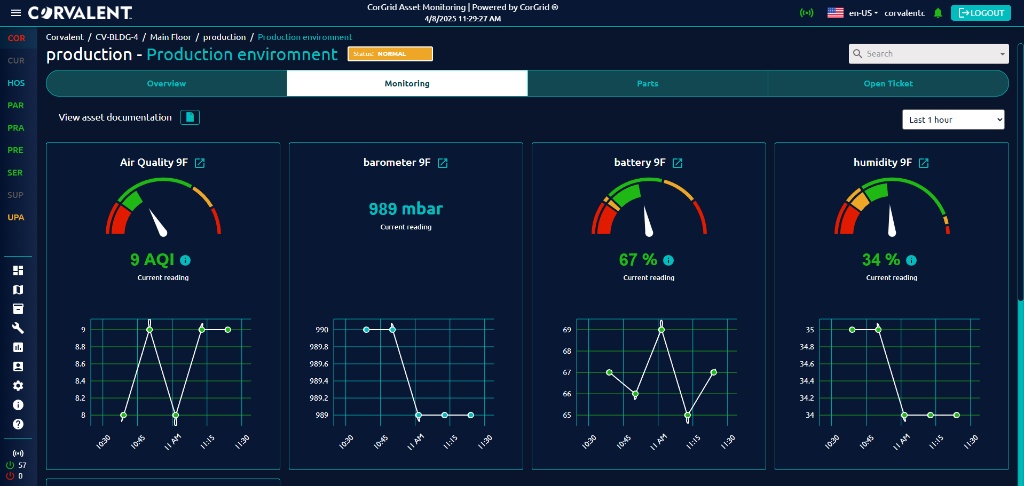
Sensor Monitoring
Real time gauges and historical trend charts for environmental and equipment sensors — air quality, barometric pressure, battery level, and humidity — with drill-down detail on demand.
Where We Go From Here
Innovation Potential and Next Steps
Clayco's combination of integrated project delivery, engineering expertise, BIM and VDC capabilities, sustainability services, cloud infrastructure, systems integration expertise, and interest in advanced analytics creates strong alignment with Corvalent's Smart Building vision.
Opportunity 1
Internal Application at Clayco
The application of CorGrid within Clayco's own facilities, projects, or operational workflows — demonstrating real time monitoring, predictive analytics, AI insights, energy management, ESG visibility, and multi site management.
Opportunity 2
A Technology Layer for Customer Projects
Potentially larger: evaluating CorGrid as a Smart Building technology layer that Clayco could incorporate into selected customer projects, extending the value of its design build and systems integration capabilities into the operational lifecycle of the facilities it delivers.
Proposed Discovery & Technical Alignment Session
A representative building, facility, or customer project
Existing building systems and available data sources
High value operational and sustainability KPIs
Priority assets for predictive monitoring
Existing BIM, BMS, and cloud integration opportunities
AI and analytics requirements
A focused Proof of Concept scope
A roadmap for potential multi building or customer deployment
"From intelligent design and construction to intelligent operation, Corvalent and Clayco have the opportunity to connect the entire building lifecycle, turning physical infrastructure into continuously measurable, adaptive, and increasingly intelligent environments."
•Sources: Deloitte — Driving Efficiency and Effectiveness with Smart Buildings; Building a Sustainable Future with Smart Buildings. McKinsey & Company — How Disruptive Technologies Are Opening Up Innovative Opportunities in Services; Imagining Construction's Digital Future.
Ready to take the first step?
Let's schedule a Discovery & Technical Alignment meeting to explore how Corvalent and CorGrid can support Clayco's Smart Building and Special Projects initiatives.
Supporting documentation, audio, and video for deeper review of the Smart Building & Special Projects proposal. Files below are placeholders — the Corvalent team will attach final assets.
Smart Building & Special Projects — Full Proposal
Complete proposal deck prepared for Clayco: strategic context, CorGrid platform, value areas, technologies, benefits, and next steps.
PDFComing soon
Exclusive for Clayco
Smart Building & Special Projects — Podcast
An exclusive audio walkthrough of the proposal: how CorGrid can bring operational intelligence to Clayco's buildings and customer projects.
External Industry References:
Deloitte: Smart Building Solutions; Driving Efficiency and Effectiveness with Smart Buildings; Building a Sustainable Future with Smart Buildings.
McKinsey & Company: Laying the Foundation for Success in the Connected Building Era; How Disruptive Technologies Are Opening Up Innovative Opportunities in Services; Imagining Construction's Digital Future.